





In this article, Ascend Digital, as an Odoo Strategic Partner, invites you to imagine a typical working day.
Sales figures are stored in the sales team’s Excel files. Actual stock is kept in the warehouse. Accounting records are handled by an external accounting firm, while sales and purchasing documents are scattered across LINE chats.
If this sounds familiar and has become normal in your company, it may mean your business is growing beyond what manual processes can handle. This is where an ERP system starts to play an important role.
This article will help you understand ERP without complicated IT terminology and explore why now is a good time for Thai SMEs to get started.
ERP Explained Simply: What Exactly Is It?
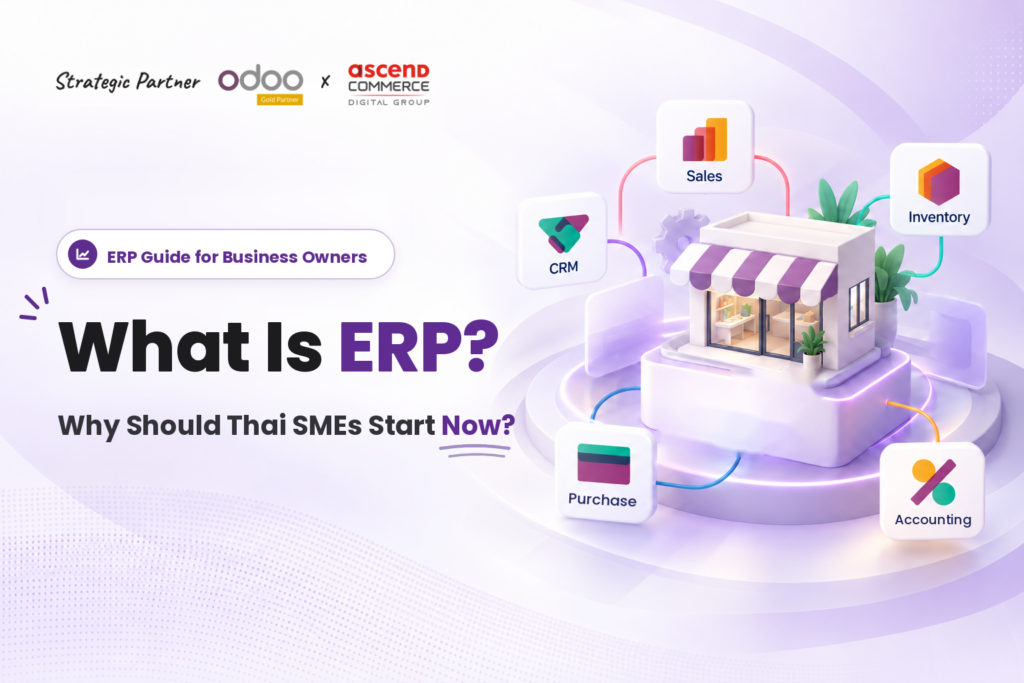
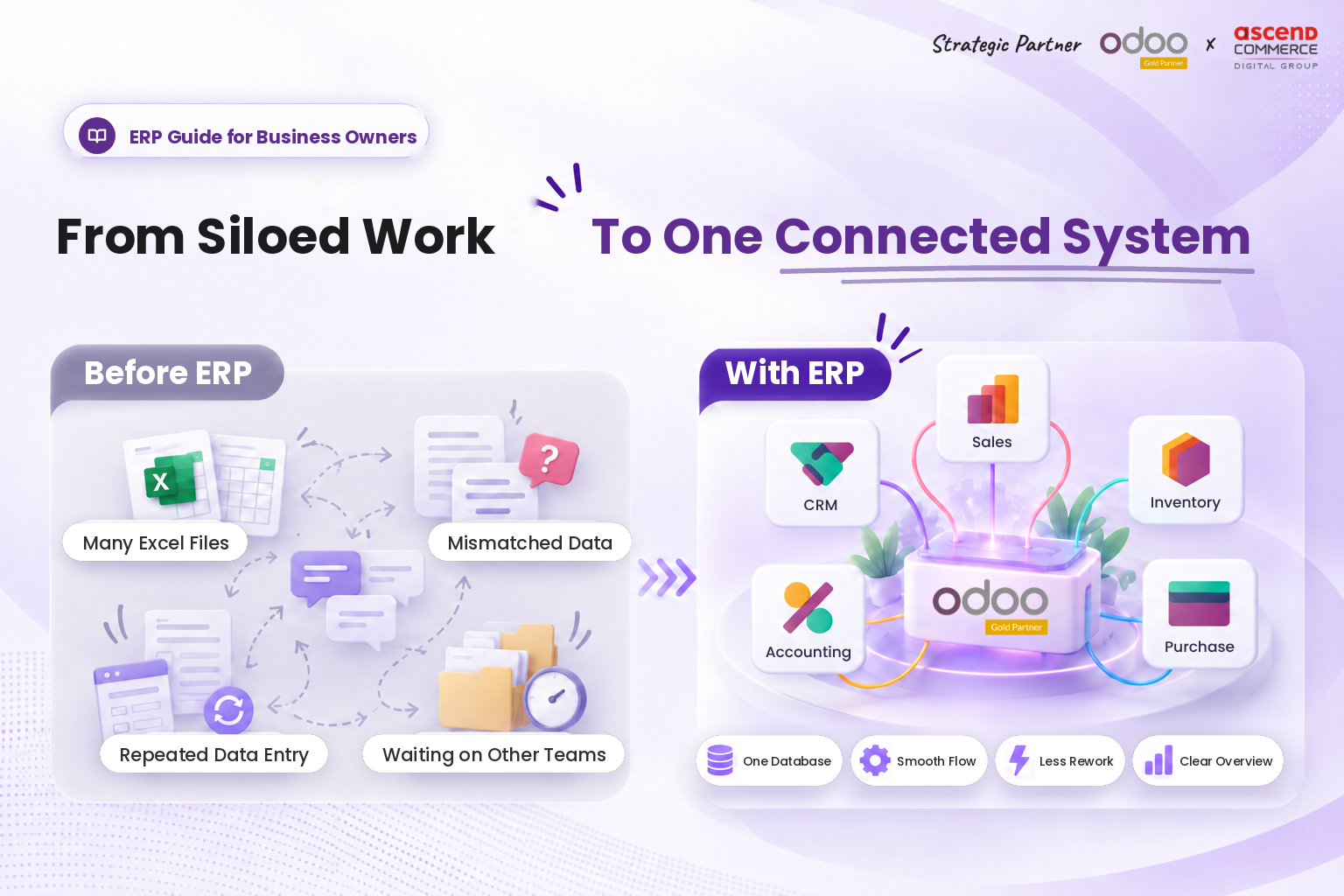
ERP (Enterprise Resource Planning), simply put, is a central system that connects all departments within a company.
Imagine each department working on its own island. Sales, Inventory, Purchasing, and Accounting all maintain separate files. Every time information needs to be shared, employees have to enter the same data repeatedly.
With ERP, however, everyone works from the same database. For example:
- The sales team creates a sales order in the system.
- The warehouse immediately sees the order without waiting for a LINE message.
- The purchasing team knows when stock is running low and needs replenishment.
- The accounting team can use the information to generate invoices.
Instead of duplicated work and delays between departments, everything can flow smoothly within a single system.
How Does ERP Work in Real Life?
Modern ERP systems are typically divided into modules or applications, each supporting a different business function, such as:
- CRM & Sales: Manage customers and sales activities.
- Inventory: Manage warehouses and stock.
- Purchase: Manage purchasing and procurement.
- Accounting: Record and summarise financial information.
- Manufacturing: Manage production processes.
The best part is that you don’t need to implement every module from day one.
Modern cloud-based ERP systems allow businesses to start with only the applications they need. For example, you can begin with Sales and Inventory, then add Accounting or Manufacturing as your business grows.
This allows SMEs to get started without having to invest heavily in servers or a complete system upfront.
How Is ERP Different from Accounting Software?
A common question is: “We already use accounting software. Why should we invest in ERP?”
The simplest way to understand the difference is that accounting software mainly records what has already happened from a financial perspective, such as income, expenses, and financial summaries.
ERP, on the other hand, manages business processes from the very beginning — from customer enquiries and product reservations to inventory deductions, delivery orders, and payments.
Accounting information can then be generated automatically from everyday business activities, reducing the need for accounting teams to chase documents or manually enter historical data.
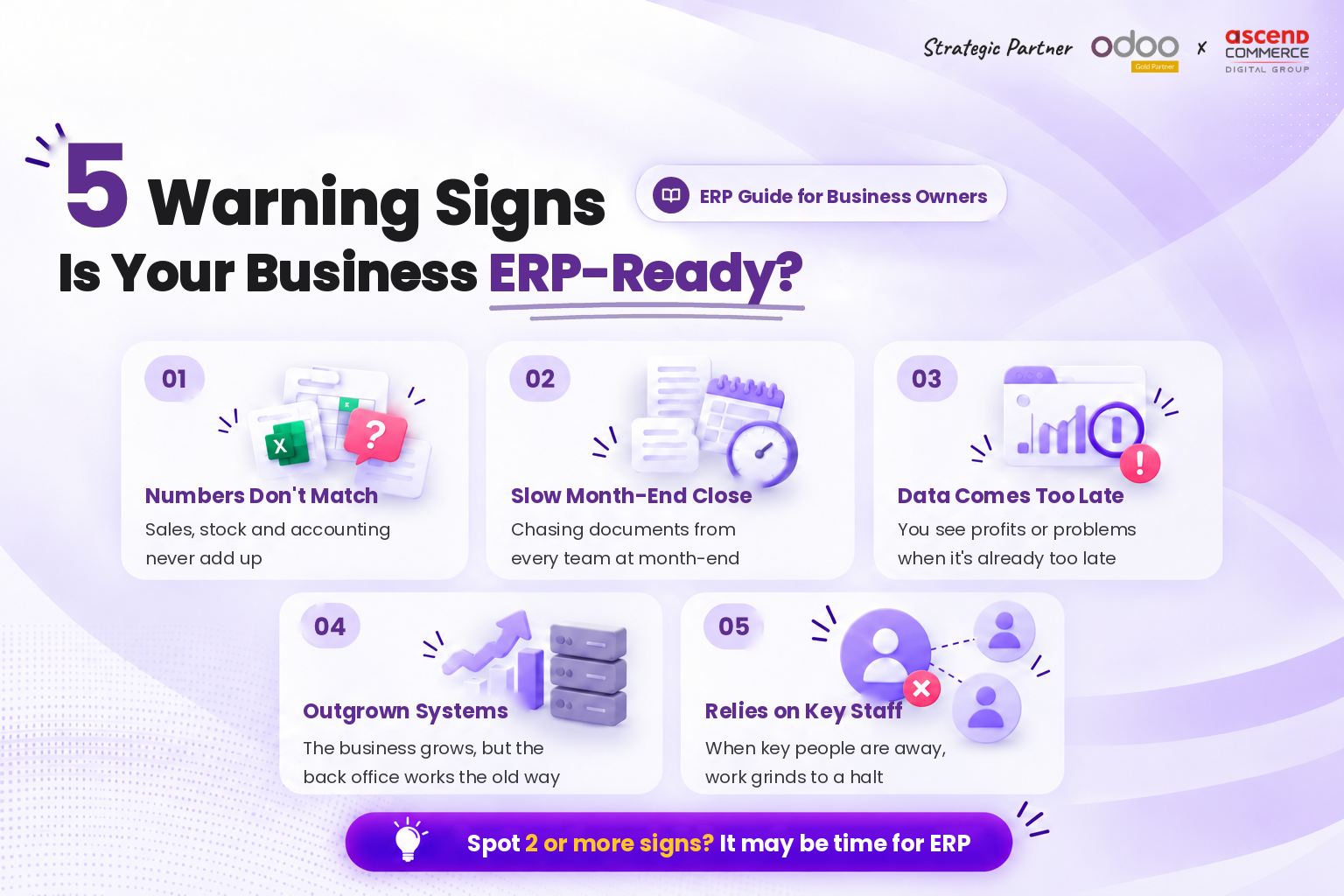
5 Warning Signs: Is It Time for Your SME to Implement ERP?
Take a look at whether your business is experiencing any of these situations:
- Your numbers never match. Sales figures in Excel don’t match accounting records, or actual warehouse stock doesn’t match inventory reports.
- Month-end closing takes too long. Every month, the accounting team spends days collecting documents from different departments.
- You’re managing your business through the rear-view mirror. By the time you discover which products are profitable or which projects are losing money, you have already waited until the end of the month — often too late to act.
- Your existing systems can’t keep up with growth. You’re opening more branches and selling through multiple channels, but your back-office processes remain unchanged and start causing operational bottlenecks.
- Operations stop when key employees are absent. Important information and working procedures depend on individuals rather than being stored in a central system.
Our recommendation: If your business is experiencing two or more of these warning signs, it may be time to reorganise your back-office systems before these challenges become barriers to growth.
Why Should Thai SMEs Start Implementing ERP Now?
Running a business isn’t just about internal operations. Several external factors are also pushing Thai businesses to adapt:
1. Increasing Competition
Thailand has more than 3.2 million SMEs, representing almost the entire business sector. Competition is increasingly driven by speed. Businesses with more accurate information, better visibility into actual costs, and faster decision-making have a competitive advantage.
2. The Shift Towards Digital Tax Systems
Thailand’s Revenue Department continues to promote e-Tax Invoice & e-Receipt and e-Withholding Tax systems. The Thai Cabinet has also approved an extension of tax incentives allowing eligible expenses related to electronic tax systems to qualify for a deduction of up to twice the amount spent, through the end of 2027, subject to applicable conditions.
Implementing an ERP system that supports these requirements can help businesses improve their operations while potentially benefiting from relevant tax incentives.
3. More Affordable Technology
Forget the days when ERP systems required investments of millions of baht. Today, subscription-based ERP solutions make the technology more accessible, allowing businesses to pay based on their usage and requirements.
4. Preparing for the AI Era
AI needs clean, well-organised data to deliver meaningful results. Implementing ERP today helps businesses build a structured data foundation, preparing them to use AI for business analysis in the future.
Why Is Odoo ERP a Great Fit for Modern SMEs?
When it comes to flexible and cost-effective ERP solutions, Odoo is often among the top choices.
Odoo is a rapidly growing ERP platform from Belgium, with tens of millions of users worldwide.
Its key strengths include a user-friendly interface similar to smartphone applications, making it easier for employees to learn and use, along with a comprehensive range of business applications.
However, the main challenge of implementing Odoo in Thailand isn’t necessarily the software itself. It’s adapting the system to Thai accounting and tax requirements, including VAT, Withholding Tax, and e-Tax Invoice.
This requires specialists who understand both the technology and the regulations of the Thai Revenue Department.
Implement Odoo ERP with Confidence — With WeOmni
Choosing the right software is only half the journey. The other half is choosing a partner who truly understands your business.
WeOmni by Ascend Commerce Digital is Thailand’s first and only Odoo Strategic Partner, with a direct strategic partnership with Odoo, alongside its Gold Partner accreditation.
We don’t simply install software. We take the time to understand your business processes and design a system that supports how your business actually operates.
- Certified Experts: Odoo-certified specialists with hands-on experience in both business processes and IT implementation.
- Thai Localization Package: Additional modules specifically developed for Thai businesses, supporting VAT, Withholding Tax, and e-Tax Invoice requirements of the Thai Revenue Department.
- Industry Expertise: In-depth understanding of Retail, eCommerce, Distribution, and Manufacturing, helping businesses seamlessly connect front-office and back-office operations.
- End-to-End Support: Continuous support after implementation, including system updates, new features, and emerging Odoo AI capabilities to help your business keep moving forward.
Ready to Turn Your Back Office into a Driver of Business Growth?
Talk to the Odoo ERP specialists at WeOmni for a complimentary initial business consultation and system demo.
 Book Your Free Odoo ERP Consultation: https://weomni.com/odoo/