








Rising costs, delayed deliveries, production waste, and budgets running over plan… If you are a factory executive or responsible for managing a production line, you have likely faced some of these challenges.
Today, Thailand’s manufacturing sector is facing increasingly complex challenges, including price competition, fluctuating raw material costs, and growing customer expectations for products that are “faster, but at a lower price.” However, many factories are still relying on manual processes such as:
- Phantom Stock: Inventory numbers in the system never match the actual raw materials available on the shop floor.
- Paper Work Orders: Documents are passed from person to person, increasing the risk of being lost or recorded incorrectly.
- Countless Versions of Excel Files: Production planning relies on spreadsheets that are edited repeatedly until no one knows which version is the latest.
When production depends on “guesswork” or “the experience of shop floor workers,” operations can easily be disrupted if a key employee is absent or an Excel file has an issue. This can cause production lines to slow down immediately, resulting in longer lead times, higher hidden costs, and ultimately affecting business reliability.
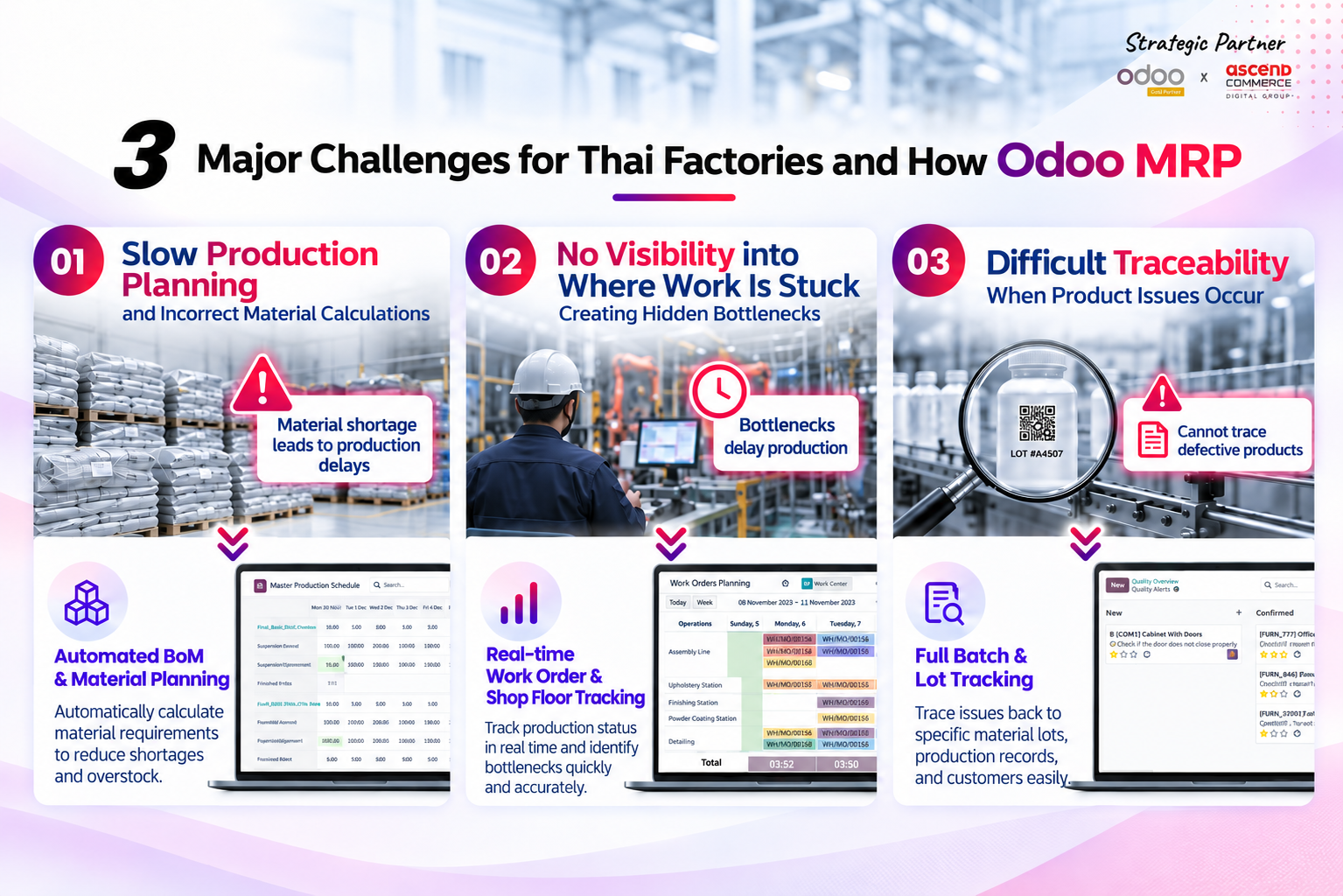
3 Major Challenges for Thai Factories and How Odoo MRP Helps Solve Them
From WeOmni’s experience as an Odoo Strategic Partner, supporting the transformation of multiple manufacturing businesses, these are three of the most common challenges we have seen—and how Odoo MRP can help address them directly:
1. Slow Production Planning and Incorrect Material Calculations
Use Automated BoM & Material Planning to automatically calculate the materials required based on orders. This helps prevent material shortages on the shop floor, one of the key causes of production delays. It also helps avoid purchasing excessive raw materials that tie up capital unnecessarily and may affect the company’s financial balance.
2. No Visibility into Where Work Is Stuck, Creating Hidden Bottlenecks
Make production status easier to track through Real-Time Work Order & Shop Floor Tracking, allowing supervisors and managers to immediately see the overall production status at every stage on a dashboard. They can identify which machine, work center, or process is creating a bottleneck and take corrective action quickly and accurately.
3. Difficult Traceability When Product Issues Occur
Full Batch & Lot Tracking allows businesses to trace issues back to the specific raw material lot, identify who produced the product, and see which customer received it. This supports international standards such as ISO and makes audit preparation easier, while helping reduce losses related to affected lots.
4 Highlight Features in Odoo MRP That Elevate Production to International Standards
What makes Odoo Manufacturing (MRP) different from traditional ERP systems is its ability to connect “raw materials – machines – employees – sales” within one integrated system through four key features:
1. Smart Multi-Level BoM
- Define complex Bills of Materials (BoMs) and detailed production processes based on your business requirements. The system helps calculate Actual Cost more accurately. When a BoM is updated, the information is synchronized with Purchasing and Manufacturing, helping reduce communication errors.
2. Work Order Automation — Say Goodbye to Paper Work Orders
- Employees can receive work assignments, record working time, and view drawings through tablets or touch screens directly on the shop floor. The system helps prioritize work based on due dates and automatically evaluates work center capacity.
3. End-to-End QC & Quality Control
- Control quality from incoming raw material inspections through to finished products. This helps reduce defective production, and when a customer complaint occurs, teams can trace the root cause within just a few clicks.
4. Seamless Integration Between Sales and the Supply Chain
- When the Sales team closes a deal in Odoo CRM, the system automatically checks inventory availability. If there is insufficient stock, the system can create a Manufacturing Order (MO) and immediately alert the Purchasing team. Information flows smoothly across departments without being missed.
Measurable Results After Implementing Odoo MRP
Operational Area | Before Odoo MRP | After Odoo MRP |
Production Lead Time | Continuously extended and difficult to predict | Reduced by 20–30% through automated work prioritization |
On-Time Delivery | Frequent delays due to material shortages | Significantly more accurate because planning is based on actual data |
Cost of Goods Sold (COGS) | Difficult to control, with high hidden costs | Noticeably reduced by minimizing scrap and rework |
Unlocking production bottlenecks starts with a system that understands how people actually work.
Every factory has different levels of complexity in its manufacturing processes. Therefore, there is no one-size-fits-all approach to implementing an MRP system.
The WeOmni team is ready to help you identify pain points on the shop floor, redesign workflows with Odoo MRP to reduce employees’ paperwork, and connect every department so that everyone works from the same view of information.
Backed by proven expertise: WeOmni — Thailand’s first and only Odoo Strategic Partner — is ready to help your factory move toward a more accurate and measurable manufacturing operation.
👉 Stop wasting time on phantom stock and complicated paperwork.
Talk to WeOmni’s Odoo experts at https://weomni.com/odoo/