








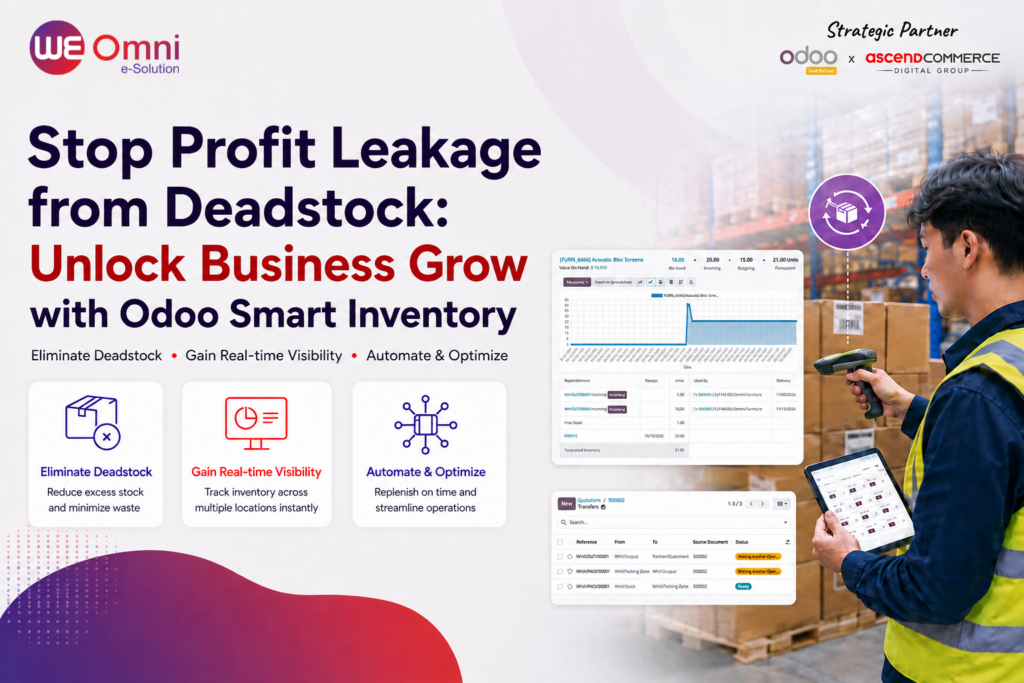
Ever had products sell out at the store while excess stock sits in the warehouse until it expires? If this sounds familiar, your inventory may be quietly eating into your profit margins.
Today, WeOmni, an Odoo Strategic Partner, takes a closer look at what causes these inventory challenges—and the Odoo features that can help businesses reduce costs, improve efficiency, and manage inventory more effectively.
Did you know that many warehouses and retail businesses can lose as much as 15–20% of their profits every year due to inefficient inventory management?
One of the biggest challenges is finding the right balance. Too little inventory can lead to stockouts and lost sales opportunities, while ordering too much can turn valuable working capital into deadstock.
This makes excess inventory a silent drain on cash flow that can limit business growth.
The challenge becomes even greater when you operate multiple branches, warehouses, and sales channels. If your teams still rely heavily on Excel spreadsheets or manual records, it becomes increasingly difficult to know your true inventory position in real time.
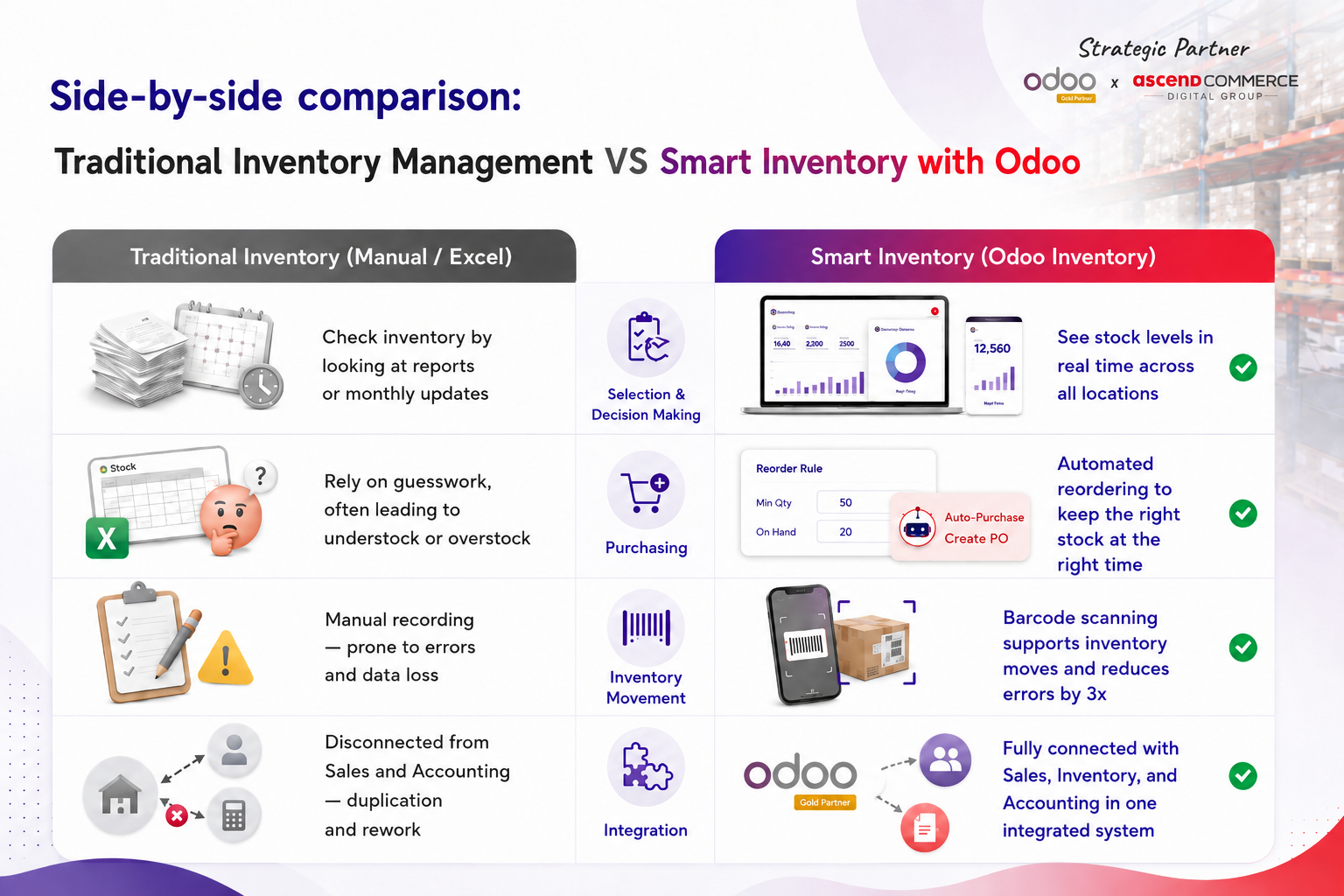
Odoo officially supports real-time warehouse operations, barcode-based workflows, multi-warehouse management, automated replenishment, and integration with other business applications.
🛠️ 4 Strategic Pillars to Help Protect Your Profit with Odoo
Odoo Inventory is more than a system for recording products moving in and out of a warehouse.
When implemented effectively, it can become a strategic tool for protecting margins, improving working capital, and increasing operational efficiency.
Here are four key capabilities:
1. Gain Real-Time Inventory Visibility Across Every Location
Whether you operate a central warehouse, multiple stores, distribution centers, or several storage locations, Odoo allows your teams to see where products are located and how much inventory is available from a centralized system.
This helps reduce situations where sales teams promise products that are not actually available, while making inter-warehouse transfers easier to manage. Odoo also supports multi-warehouse operations, including transfers between warehouses and locations within the same system.
2. Improve Traceability with Lots & Serial Numbers
For businesses managing products that require detailed traceability, Odoo supports tracking through Lot Numbers and Serial Numbers.
This is particularly valuable for products with expiration dates, regulated goods, manufacturing components, or products requiring after-sales traceability. Odoo also supports inventory removal strategies such as FIFO (First In, First Out) and FEFO (First Expired, First Out) to help businesses determine which inventory should be picked first.
For businesses dealing with expiration-sensitive products, FEFO is especially useful because it prioritizes products based on their expiration dates.
3. Digitize Warehouse Operations with Barcode
Move away from paper-based warehouse processes. With Odoo Barcode, warehouse teams can use barcode scanners and compatible mobile devices to support day-to-day operations such as:
Receiving → Putaway → Picking → Transfers → Inventory Adjustments
This reduces repetitive manual data entry, helps prevent human error, and enables warehouse transactions to be updated directly in the system. Odoo Barcode supports inventory movements as well as lot and serial number scanning, helping teams improve both speed and traceability.
4. Optimize Working Capital and Reduce Excess Inventory
Inventory is not simply stock sitting on a shelf—it is working capital tied up in your operations. Odoo’s Reordering Rules allow businesses to define minimum and maximum inventory levels. When forecasted stock falls below a defined threshold, the system can trigger the appropriate replenishment process. For products using the Buy route, for example, Odoo can generate a Request for Quotation (RFQ) as part of the replenishment workflow.
This helps businesses maintain sufficient inventory to support customer demand while reducing unnecessary capital tied up in excess stock.
Build Smarter Inventory Operations with Odoo and WeOmni
Building an effective inventory system is not simply about implementing new software.
It requires redesigning the end-to-end operational workflow—from receiving and storage to picking, replenishment, and delivery—to match the way your business actually operates.
As an Odoo Strategic Partner in Thailand, WeOmni helps businesses design and implement Odoo Inventory as part of a connected business ecosystem—integrating inventory with Sales, Purchase, Accounting, and other critical business processes.
The objective is not only to improve warehouse efficiency, but also to reduce financial leakage, improve working capital visibility, and build a scalable foundation for sustainable growth.
“A high-performing warehouse is not one filled with the most inventory.
It is one that has the right products, in the right place, at the right time—and can turn inventory into cash as efficiently as possible.”
Ready to transform your inventory operations, reduce deadstock, and unlock more value from your working capital?
🌐 Talk to WeOmni today for an end-to-end consultation on ERP and Odoo Inventory implementation. 👉 https://weomni.com/odoo/